In this article, you’ll learn how modern JavaScript syntax changes the shape of code, and which examples need context in a post-ES2015 world. That matters because durable engineering comes from understanding trade-offs, not merely reproducing a command or pattern.
This post includes a few notes on ECMA language features that I like as well as some info on memory leaking. I have no doubt that it will read disjointed; I started this eons ago and only now have I decided to publish it.
A simple reminder of what Node.js is …it is a set of APIs wrapped around the V8 Engine (written in c++) and is a high-performance JavaScript and WebAssembly engine.
ES2015 (ES6)
Class
I find JavaScript messy at the best of times. When things are messy, personally I find it difficult to see the forest through the trees, and by this I mean, have I coded for all the *-cases (use/edge/corner)? Or worse, can I see the existing defects or bug breaders?! Then there’s the lack of readability.
I’ve discussed the use of classes with many Engineers and I have had a mixed reception but in the main, most said they preferred the simplicity of arrow functions. Not sure if there is a right or wrong answer to this (bit like the tabs or spaces…tabs, obvs!)… and at one time I will have agreed with the majority. Now though is a different story. Like so many others, I too have drank the cool-aid on TypeScript and now the only reason I can see myself opting for JavaScript in the future is mainly for legacy reasons.
Coming from an OOP background, I naturally gravitate towards constructs like classes:
class Admin extends User
{
    constructor (name) {
        super(name)
        this.initialize()
    }
    initialize = () => {}
}
Destructuring
const getProfile = () => {
  return {firstname: "garrard", lastname: "kitchen", married: true, children: 2}
}

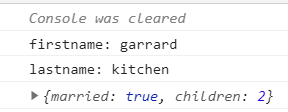
const {firstname, lastname, ...family} = getProfile()

console.log(`firstname: ${firstname}`)
console.log(`lastname: ${lastname}`)
console.log(family)
This would result in:
Arrow function
Arrow functions are a great addition to the ES spec! Their scope is purely inside of it’s closure and is not affected by the this context which may hoisted functions fall victum of.
initialize = () => {}ES2016 (ES7) Language Features
The Decorator
Awesome addition to the EMCA family!
I’ve used this with great affect with Typescript, and mostly with NestJS solutions.
This is a contrived example on how you can use very basic decorator on a class function:
You must have configured your solution to use babel
class Content {
    @link('nodejs', "<a href='https://nodejs.org/en/'>Node.js</a>")
    html() {
        return `This server language is called nodejs!`
    }
}

function link(_find, _replace) {
    return function(target, key, descriptor) {
      var old = descriptor.value()
      descriptor.value = () => {
        var n = old.replace(_find, _replace)
        return n
      }
    }
}

const m = new Content()
console.log(m.html())
output:
[nodemon] restarting due to changes...
[nodemon] starting `babel-node index.js`
This server language is called <a href='https://nodejs.org/en/'>Node.js</a>!
[nodemon] clean exit - waiting for changes before restart
package.json:
...
  "scripts": {
    "start": "nodemon --exec babel-node index.js"
  },
...
  "devDependencies": {
    "@babel/core": "^7.12.3",
    "@babel/node": "^7.12.1",
    "nodemon": "^2.0.6"
  },
  "dependencies": {
    "@babel/plugin-proposal-decorators": "^7.12.1"
  }
...
.babelrc:
{
  "plugins": [
    ["@babel/plugin-proposal-decorators", {
      "legacy": true
    }]
  ]
}
ES2018 (ES9)
Spread
I was reminded of something useful this morning (on the morning I wrote this, originally!) from a youtube video I was watching. JS passes objects (non-primitives) by reference, ergo, memory pointers, so it is possible to effect an object outside of it’s closure. So, imagine you return an array of objects (e.g. from a service to a controller). It is possible, to effect this array of objects from within the controller. One way I have found to avoid this is by using the spread syntax:
private readonly list: string[]
getList() {
   return list
}
you can do this:
getList() {
    return [...list]
}
Obvs, the 👆 is using an array but you can do this same with an object too {…list}
Memory
Functions arguments passed by value; always
See also spread 👆 to for advance on how to avoid memory leakage.
Further to the above, JS always passes by value (not reference) ALL augments to a function. This means that, if you pass in an argument (primitive or object) into a function, the closure is honoured and therefore any changes made to this value inside the closure is not reflected outside, example:
let v: string = "A"
getValue(v){
  v = v + "B"
}
let result = getValue(v)
console.log(result) // output: AB
console.log(v) // output: A
2026 technical review
Technical review: language and proposal status
ES2015 introduced classes, destructuring, arrow functions, modules, let and const, and more; ES2016 was a much smaller annual release. Decorators were not an ES2016 language feature. For years, Babel and TypeScript implemented experimental decorator designs that differ from the current standardised proposal semantics. Code using legacy decorators must be checked against the exact compiler options and framework version before migration.
JavaScript arguments are passed by value. For an object, the value being copied is a reference to the object; mutation through that reference can therefore be observed by the caller, while reassigning the local parameter cannot replace the caller’s variable.
Prefer const by default, use let for rebinding, and treat class syntax as one way to build objects rather than as proof that JavaScript adopted classical inheritance internally. Modules and package boundaries usually matter more to maintainability than any individual syntax feature.
Closing thought
JavaScript syntax will keep evolving; the durable skill is recognising which changes clarify intent and which merely make familiar code look newer.